As a speech-language therapist, a person who stutters, and a doctoral candidate researching stigma and representation, I often find myself navigating two seemingly distinct worlds: the clinical and the critical. The ‘Bridging Dysfluency Theory and Clinical Practice’ workshop series was the first training I encountered that deliberately built a bridge between these worlds – namely between speech-language therapy and Critical Disability Studies (CDS). For me, this was a long-overdue but deeply meaningful encounter.
While speech-language therapy (SLT) remains largely rooted in the medical model of disability – focused on diagnosis, treatment and normalization – CDS interrogates the very assumptions underpinning this model. It shifts the conversation from what’s ‘wrong’ with a body to how social, political, and cultural contexts construct and constrain disabled lives. As Donya Mosleh (2019) argues, these two disciplines have long occupied opposite ends of a spectrum, yet the tensions between them are not only reconcilable, but fertile ground for transformation. She writes, “CDS with rehabilitation unsettles knowledge relations that position these two fields as oppositional and incompatible” (p. 1) and invites us instead to see their differences as a space for creative engagement and mutual enrichment.
The workshop series embraced this spirit of dialogue. It did not just ask us to reflect on stuttering as a speech difference – it asked us to reimagine the clinical frame through which we approach dysfluency.
From theory to practice: What the workshop series offered me
As someone who stutters and engages daily with the values of disability justice and representation, I have long been drawn to Critical Disability Studies. But I have also often asked myself: how can I bring these frameworks into the therapy room? This training finally answered that question – not in abstract terms, but through grounded, tangible ideas that directly inform therapeutic practice.
The trio of facilitators – Josh St. Pierre, Sam Simpson, and Christopher Constantino – offered a rare and powerful combination of perspectives. A critical disability theorist, a seasoned clinician, and a professor and clinician specializing in stuttering came together to articulate a new paradigm: one where therapy affirms stuttering as a valid, valuable, and even desirable form of communication.
More than just a collection of concepts, the workshop series offered a framework for action. It helped us, as clinicians, think not only about what we do, but why we do it. It helped us confront our assumptions about fluency, normalcy, and success. And it gave us concrete tools to move from a model of correction to one of affirmation, co-construction, and social change.
For me, it was both deeply validating and profoundly useful. It showed me that therapy does not have to simply accept (or worse, erase) stuttering by folding it neatly into existing norms. It can make room for stuttering to take up space – messy, beautiful, and real – with confidence, complexity, and care.
Three transformative concepts that stayed with me
Each contributor brought a powerful lens to rethink our role as clinicians – and to reimagine what therapy can become when it is stutter-affirming.
Josh St. Pierre offered a conceptual framework that continues to resonate with me: three forms of belonging – curative, inclusive, and transformative. These are not just abstract categories; they are ways in which people who stutter are positioned in relation to the world around them. Curative belonging says: you may belong if you become fluent. Inclusive belonging suggests that you can be accepted, as long as you do not disrupt established systems. But transformative belonging goes further. It imagines a world that grows around stuttering, not despite it. It calls for a reconfiguration of norms – where stuttering is not something to overcome, but something that opens new ways of being, relating, and imagining. As both a person who stutters and a clinician, this concept felt like a profound invitation to rethink the very foundations of therapeutic care.
Christopher Constantino extended this invitation by asking: what would it mean to want to stutter? He offered a vision of therapy that moves away from control and toward spontaneity. His notion of ‘stutterphilic’ reactions – being present with dysfluency, rather than resisting it – shifts the focus from fluency as an endpoint to speech as a site of connection and joy. What stayed with me is not just the conceptual boldness of his ideas, but their therapeutic potential. His approach encourages clients (and clinicians) to unlearn the reflex of avoidance and instead cultivate comfort, curiosity, and even delight in dysfluency.
Sam Simpson brought all of this into the heart of the therapeutic relationship. What helped me most were the concrete tools she provided to explore stuttering in an anti-oppressive, trauma-informed, and stutter-affirming way. Among other things, she shared reflective questions that clinicians can use with clients, to unpack cultural knowledge, ableist norms, and internalized assumptions about speech. For example, how do we recognize ableist listening practices in daily life? How do we talk about stuttering with others? What has stuttering taught us about ourselves and the world? These questions open up space in therapy for identity work, cultural exploration, and political awareness.
What also made a difference for me was the space she and the team created during the sessions. There was time for small group conversations, large group reflections, and genuine dialogue. We were not just listening – we were being listened to.
A shift in practice – and in hope
What excites me most about this training is that it finally offered concrete ways to bring Critical Disability Studies into speech-language therapy. I had long been searching for guidance on how to apply them in clinical settings. This training bridged that gap. It translated values like transformative belonging, anti-oppressive practice, and stuttering pride into tools and reflections that can shape real therapeutic encounters.
I hope other clinicians will see this as an invitation: to think critically, to question old assumptions, and to embrace therapy that honours dysfluency as meaningful and valuable. This training gave me hope – not just for how we can support people who stutter, but for how our field itself can evolve.
By Geneviève Lamoureux
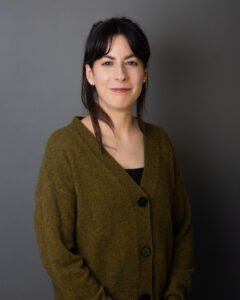
Geneviève Lamoureux is a speech-language therapist, doctoral candidate in speech-language sciences at the Université de Montréal, and a person who stutters. Her research explores how media representations of communicational diversity – such as stuttering – can help reduce stigma, drawing on the philosophy of neurodiversity to promote a greater appreciation of diverse ways of speaking.
Geneviève is affiliated with the Laboratoire d’innovations en orthophonie (Labo IV), the Labo CinéMédias, and the Centre de recherche interdisciplinaire en réadaptation du Montréal métropolitain (CRIR). She also collaborates with the Clinique spécialisée en bégaiement et bredouillement and leads projects at the Association bégaiement communication (ABC), where she co-produces and co-hosts Je je je suis un podcast, one of the first French-language podcasts dedicated to stuttering.
She can be reached at genevieve.lamoureux@umontreal.ca.
Reference
Mosleh, D. (2019). Critical disability studies with rehabilitation: re-thinking the human in rehabilitation research and practice. J Human Rehab, 1-12.